From the archives · 2023
The Bifocal ADG Operating Model: Building for Responsiveness and Resilience
The Bifocal ADG Operating Model helps organizations build external responsiveness and internal resilience across six connected dimensions.
Csaba Csényi · 2026-08-19
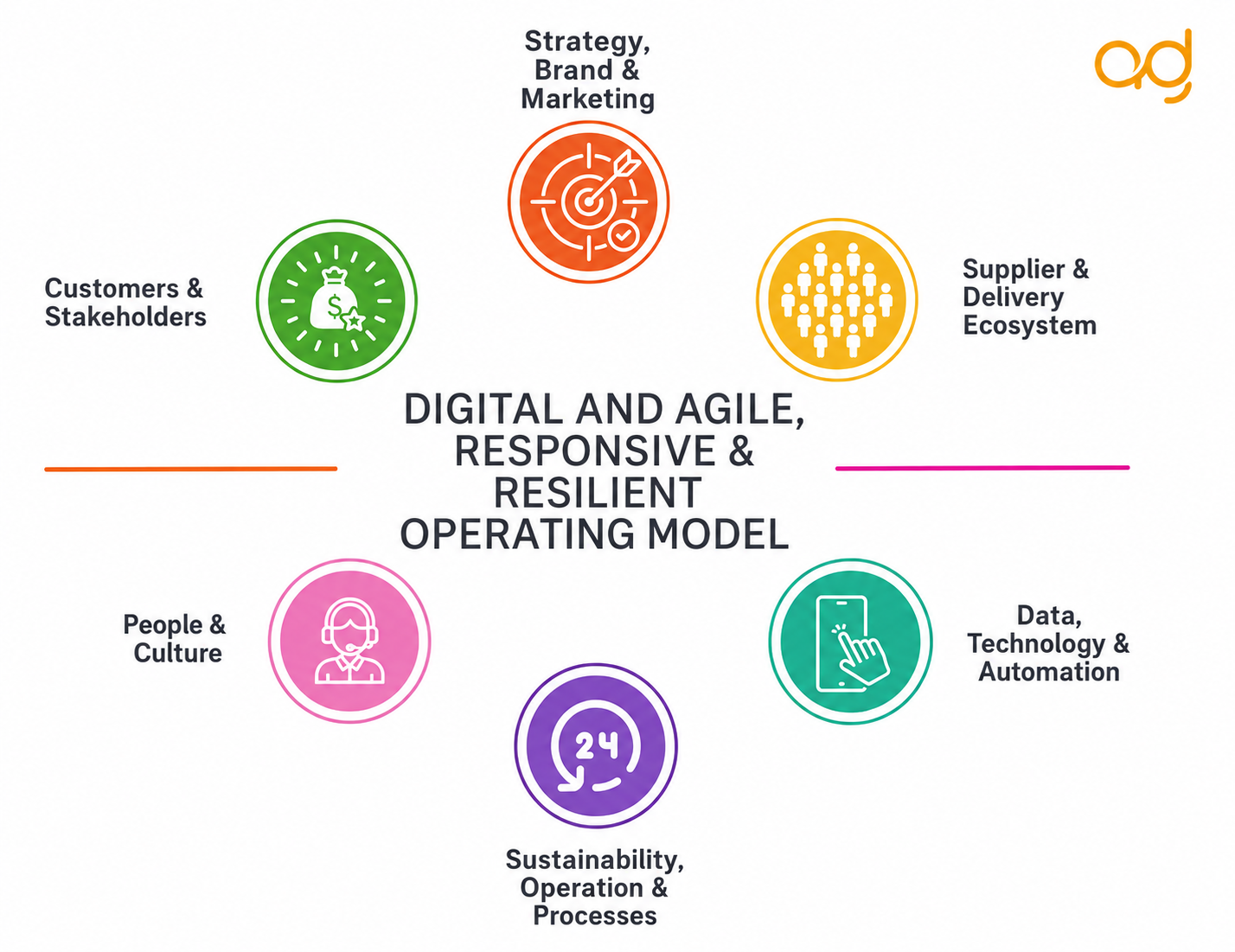
Organizations don't operate in isolation. They continuously respond to customers, competitors, technologies, regulators, communities and changing markets. At the same time, they depend on their own people, culture, processes, data and capabilities to respond effectively.
Looking at either side independently provides only half the picture.
This thinking led us to develop the Bifocal ADG Operating Model: a six-dimensional framework designed to examine an organization simultaneously from the outside in and the inside out.
Its objective is straightforward:
Build the responsiveness to adapt to what is changing outside the organization, and the resilience to respond from within.
Digital technologies, AI and agile practices can accelerate both. But they create sustainable value only when considered as part of the wider organization rather than as isolated initiatives.
Two perspectives. Six dimensions.
The Bifocal ADG Operating Model brings together three externally focused and three internally focused dimensions.
The external perspective examines how the organization understands and responds to the environment around it.
The internal perspective examines whether the organization has the capabilities and operating foundations required to respond.
Together, they provide a more complete view of whether an organization is equipped for what comes next.
The external focus: responsiveness
Organizations are participants in increasingly interconnected ecosystems. Industry boundaries are becoming less distinct, competitors can become partners, new entrants emerge rapidly, and expectations extend beyond customers to a much wider group of stakeholders.
Responsiveness therefore requires organizations to look deliberately beyond their own boundaries.
Three principles underpin this perspective:
Blurred boundaries. Industry boundaries increasingly overlap, creating opportunities for new propositions, partnerships and business models.
Coopetition. Organizations can compete in one area while collaborating in another where collective value can be created.
Constituency focus. Customers remain fundamental, but organizations increasingly need to understand the expectations of a broader group of stakeholders and communities.
The model examines this external environment through three dimensions.
1. Strategy, Brand & Marketing
Strategy determines where and how the organization chooses to compete. Brand translates what the organization stands for into an external promise. Marketing connects that proposition with the audiences the organization seeks to serve.
Their alignment shapes how clearly and consistently the business positions itself in its market.
2. Customers & Stakeholders
Understanding customers is no longer sufficient on its own.
Organizations operate within wider networks of investors, employees, regulators, partners and communities. Maintaining an open and consistent dialogue with these constituencies helps organizations understand changing expectations and identify emerging opportunities and risks.
3. Supplier & Delivery Ecosystem
Few organizations create value entirely by themselves.
Suppliers, technology providers, delivery partners and strategic alliances increasingly form part of an organization's ability to operate and grow.
Reliability, sustainability, ethics and mutual resilience therefore become more than procurement considerations. They influence the resilience of the organization itself.
Taken together, these three dimensions determine how effectively the organization senses and responds to what is happening around it.
The internal focus: resilience
External responsiveness is valuable only if the organization has the internal capacity to act.
Resilience comes from the interaction between people, operating disciplines, technology and the quality of decisions made across the organization.
Three principles underpin this side of the model:
Value-centricity. Decisions and operations should remain anchored in the value the organization seeks to create for its constituencies.
People and adaptive culture. Sustainable performance depends on people who can learn, collaborate and adapt as circumstances change.
Effective execution and data-informed decisions. Organizations need the ability to turn decisions into action while using reliable information to understand what is working.
The internal perspective therefore examines another three dimensions.
4. People & Culture
Skills alone do not make an organization future-ready.
Capabilities, behaviours, leadership and culture determine whether people can work collectively toward a shared ambition and adapt when circumstances require something different.
The objective is not simply to attract talent, but to create an environment in which individual capabilities can translate into organizational performance.
5. Sustainability, Operations & Processes
Efficient operations provide the foundation from which organizations can scale and adapt.
Processes need sufficient consistency to create reliability while remaining flexible enough to evolve. Sustainability adds another dimension: organizations increasingly need to consider the economic, social and environmental consequences of how they operate.
Efficiency and responsibility should reinforce rather than compete with one another.
6. Data, Technology & Automation
Technology, including emerging AI capabilities, can fundamentally change how organizations operate and make decisions.
But technology alone does not create transformation.
Data provides insight. Technology creates capability. Automation changes how work gets done. Their value comes from integrating them into the wider operating model rather than treating them as independent technology programmes.
Agile and digital as enabling perspectives
Agile practices and digital technologies cut across all six dimensions rather than sitting within a single box.
An agile mindset can improve an organization's ability to experiment, learn and respond. Digital technologies and AI can increase speed, connectivity, insight and automation.
The objective is not to become agile or digital for their own sake.
It is to use them where they improve the organization's ability to create and capture value.
Why take a holistic view?
Organizations are interconnected systems.
A change in one part inevitably creates consequences elsewhere.
A new technology may require different capabilities. A new business model may change processes and partnerships. New customer expectations may require different data. Rapid growth may expose weaknesses in leadership, structures or decision-making.
This is why isolated transformation initiatives frequently struggle to achieve their intended impact.
A holistic view allows leadership to understand these dependencies before deciding where to intervene.
The question is not simply which individual capability needs improving, but whether the different parts of the organization work together effectively.
From framework to application
Frameworks have little value unless they can inform decisions.
To translate the Bifocal ADG Operating Model into practical application, we developed the ADG Assessment Index.
The Index uses a proprietary 54-question collaborative self-assessment methodology to establish an organization's current position across the dimensions of responsiveness and resilience.
Its purpose is not to produce another score for management.
It is to create a structured starting point for discussion: where is the organization strong, where are the constraints, and which areas require attention if the business is to remain responsive, resilient and capable of scaling?
The resulting organizational view can then provide a baseline from which leadership prioritizes and sequences transformation initiatives.
Preparing the organization for what comes next
As businesses scale, the informal practices that served them well at an earlier stage may no longer be sufficient.
This is particularly relevant for SMEs and family businesses evolving into larger enterprises. Greater scale creates a need for clearer structures, greater consistency and stronger capabilities��without eliminating the entrepreneurial energy that created the business in the first place.
The Bifocal ADG Operating Model was developed to provide a practical way of looking at that challenge.
It does not suggest that every organization needs to transform every dimension simultaneously.
It suggests something simpler:
Before deciding what to change, understand how the organization works as a whole.
Responsiveness looks outward.
Resilience looks inward.
Sustainable performance requires both.